Thursday, March 24, 2016

Unit 7 Reflection

Unit 7 is all about the muscular system. We began with how synovial joints let us perform different actions, for example, flexion and extension. We created mini dances that included all the different movements and performed them in front of the class. It was all in good fun, but also uniquely helpful in memorizing each different synovial movement. We also learnt the basic anatomy of muscles: the major muscles in our body, and in a chicken (by dissection), such as the major and minor pectoralis, the deltoid, and the trapezius. The dissection was really cool - seeing all the different muscles and how similar they are to a humans was really impressive.
We then moved onto how muscles are separated and classified into different groups. Next, we zoned in and learnt about how muscles specifically work, right in each muscle fiber. I found the sliding filament theory particularly interesting - how the muscle shortens and lengthens when contracting and relaxing. We made a short video showing how a muscle works. It was challenging, finding a way to portray it clearly, but it was a great learning experience and it was cool how we made an actual short movie on it. Next, we moved onto how muscle fibers respond to different exercise - slow oxidative fibers in marathoners, fast oxidative fibers in a regular person, and fast glycolytic fibers in high intensity/ short burst workout, like sprinters. Finally, we covered performance enhancing substances and how the affect the mind body. The mini project for this section was that we made a satirical ad promoting P.E. substances.
The thing that really stood out to me about this is that none of them are FDA approved, or regulated in anyway, which in turn makes them all very unsafe for consumption. 
I'm really interested in learning more about performance enhancing substances, not only in the body, but those made for the mind as well. They are all so dangerous but many people treat them like no big deal - maybe not the ones aimed at body-building, but the ones that aid in focus and improve mental performance. Overall, I like a lot how my 20 time project is coming along, I'm really satisfied with my progress so far. Going back to my New Year's Goals, I am still working on more actively participating in class but in small groups I am participating a lot more. I am sleeping a fair amount every night - losing an hour to daylight saving wasn't great but I'm making it work the best I can. For horse riding, I am working hard to get to where I want to be - and hopefully a new horse is coming my way in the near future! 

Wednesday, March 23, 2016

Performance Enhancement Advertisement


Performance enhancing drugs can be very dangerous. They can affect growth, mood, overall health, and longevity. Performance enhancing substances are taken to benefit athletic performance, build muscle, increase body mass, or lose body fat. They are all unregulated, non-FDA approved, or safe. 

Thursday, March 17, 2016

Chicken Dissection Analysis

We skinned the chicken and got a good look at all the muscles, first and foremost the pectoralis major and minor. The muscles help the chicken move and hold itself up. The allow for the chicken to walk, hop, stand, and sit. For example, the pectoralis major gives chickens the ability to move its wings ventrally. The pectoralis minor allows the chicken to move its wings dorsally. The bones give the chicken its skeleton and are what allows it to have the anatomy to move. The tendons attach the muscles to the bone so that the muscles can move in different directions, which in turn allow the chicken to perform movements. 
The insertion of the muscle in the wings are quite shiny and white. When they move, the muscle is lengthened or shortened, and they glide against each other - as the chicken would when performing that movement.

Surprisingly, the chicken's muscles were quite similar to those of a human. The chicken has biceps and triceps like humans, obviously on a much smaller scale, but we quickly identified them. The trapezius was on the back, same as in humans, despite the overall difference in anatomy. It was also not hard to identify. The sartorius are on the front of the thigh, and allows for the crossing of the legs. Same on a human, they were also pretty easily spotted. The shape of a chicken is very different from a humans, but the muscles it has are not so different.

Pulls the hand back
Flexion of the leg


Includes sartorius, iliotibialis,
biceps femoris, semimebranosus,
semientendinosus, and quadriceps

Extends foot, flexes
lower leg. Allows us to
stand on our toes

Flexion of the hand
Extends the thigh,
flexes the leg


Flexes the thigh, extends
the lower leg
Deltoid: raise the upper arm/ wing
Biceps: flexion of arm/ wing
Triceps: extension of arm/ wing
                                                                            
Pulls the wing ventrally,
in most birds it allows
for flight
Lifts the wing dorsally, or
in humans in pulls the
shoulder down and forward
Extends the thigh
Pull the shoulder back


Extends the thigh
The white, shiny tendon
in the wing that attaches the
bone to muscle
Flexes the thigh, allows
crossing of legs
Our chicken,
before any cuts were made

Monday, March 14, 2016

What Happens When You Stretch?

1) "Hence when you stretch, the muscle fiber is pulled out to its full length sarcomere by sarcomere, and then the connective tissue takes up the remaining slack."

- This quote explains what happens when stretching -- how the muscle lengthens fully to accommodate what is being asked of the body. There are many sarcomeres, and a full stretch occurs when all of the sarcomeres are fully extended. 

2) "Some sources suggest that with extensive training, the stretch reflex of certain muscles can be controlled so that their is little or no reflex contraction in response to a sudden stretch."

- Some think that if people train enough, they can control which muscles stretch and which ones contract. The less contraction, the more stretch possible. It is not easy to achieve; as the sources say only the top of the top athletes achieve it.   -- but it is very rewarding once achieved.

3) "When stretching, it is easier to stretch a muscle that is relaxed than to stretch a muscle that is contracting. By taking advantage of the situations when reciprocal inhibition does occur, you can get a more effective stretch..."

- To increase the ease of stretching, it is very important to be relaxed , so contracting muscles are not opposing. Contracting certain muscles while trying to stretch others is very contradictory when trying to elongate the muscle. 

Relate & Review

This reading was about what happens when you stretch. It's important to try to control the muscle contraction when trying to stretch =, so the sarcomeres can fully extend and stretch out as much as possible; and also to improve the ease of stretching muscles. Gymnasts and dancers seem to be about to control when the muscle contractions occur, which totally changes the game when the sports are both very focused on extension of limbs. As a former gymnast and dancer, it is easy to recognize how helpful it is the be able to control sudden muscle contractions.

Monday, February 29, 2016

Unit 6 Reflection


Thursday, February 25, 2016

Owl Pellet Lab

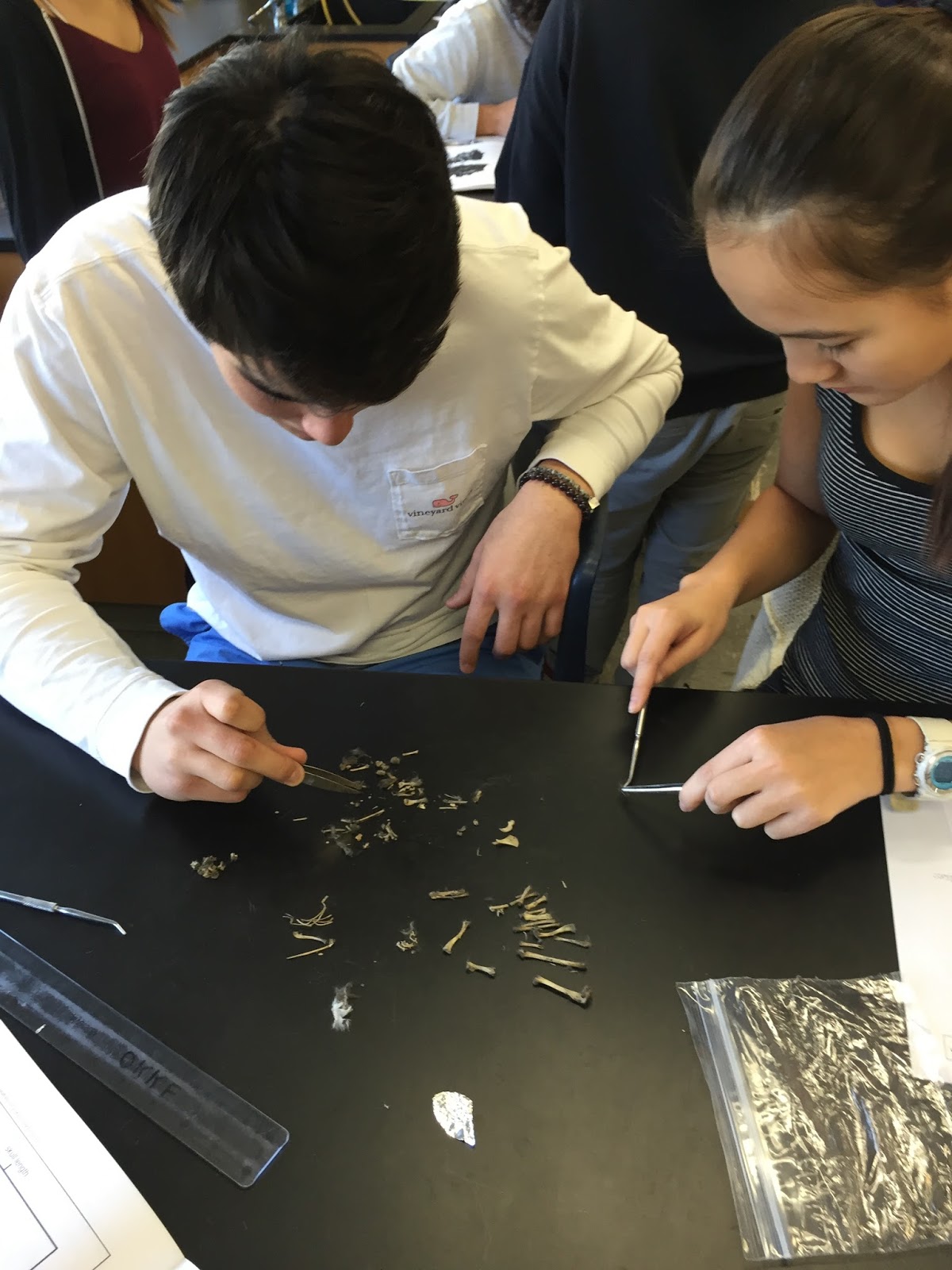
In the owl pellet lab, we were given an owl pellet (indigestible remains owls regurgitate), and broke it apart in an attempt to find out what the owl had eaten. We used forceps and a probe to pull apart the compact mass and found a lot of fur, and a broken up skeleton. We separated the bones into groups based on similarity, and then tried to find out what it was.

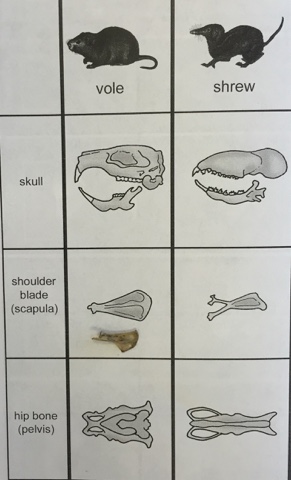
Our owl pellet skeleton was quite incomplete, there was no complete skull, which made it difficult to distinguish what it was. However, we decided that the organism was a vole -- based solely on the shape of the scapula, and the radius and ulna. The diagram of the scapula for a vole was the only one that matched up with the physical scapula bone of our organism. The radius and ulna did not match at the ends of the bones for the other small rodents, and the diagram for the radius and ulna matched the organism's bone the most closely. Despite the incomplete skeleton, we strongly concluded that it was a vole.

 The scapula and ulna and radius looked very similar to human bones -- not at all in size, but the shape of them could almost have been the same, just shrunken. In the scapula, there was a center ridge that humans do not have, but it was easy to tell that it was the same bone, just in a vole. The spine was all separated into different sections, but we also distinguished very quickly that it was the spine. It looked just like a human skeleton, of course again on a much smaller scale. A human radius and ulna and a vole radius and ulna look incredibly similar, again just minimized. 


Vole and shrew
leg bone comparison charts
Spine


Close up of scapula compared to diagram
Vole and shrew comparison chart
(skull, scapula, pelvis)
Close up of ulna and radius compared to diagram

Wednesday, January 27, 2016

Unit 5 Reflection

     This unit was about the digestive system, fuel metabolism, diabetes, obesity, metabolism, the endocrine system and the lymphatic system. For the digestive system, we learnt about the functions and the anatomy. We did the digestive system lab, where we got to see how long our digestive systems really are. It was fascination to see my height in comparison to what was inside me. Fuel metabolism was a bit more confusing for me. The body has different stages to convert food to energy so it can meet its daily needs/ requirements. There are also 3 states after eating: fed state, fasting state, and starvation state. The body uses different types of energy to keep going and ultimately survive when food is not available for a prolonged period of time. Diabetes was quite closely related to fuel metabolism as it is listed as a disruption in fuel metabolism. The body uses insulin to regulate the blood glucose level, and it happens when either the body does not make enough insulin (type 1), or it does not respond to insulin (type 2). Diabetes affects nearly 25 million Americans and staying healthy with diabetes is about correctly managing it. The endocrine system primarily controls the processes involved in movement and physiological equilibrium. There are hormones for nearly every gland and they all have different functions, whether it be growth, or regulating metabolism. Hormones are released to maintain homeostasis in the body. The lymphatic system helps immunity, lipid absorption, and fluid recovery. Lymph is a clear fluid similar to blood. It goes from lymphatic capillaries, lymphatic vessels, to lymph nodes. Lymph capillaries are nearly everywhere in the body except for CNS, bone marrow, cornea, and cartilage. Lymphocytes are white blood cells, and include T cells, B cells, and natural killer cells. The largest lymphoid organ is the spleen and the surprising thing about it is that people can live without it. A ruptured spleen is a very common abdominal trauma, and the liver and bone marrow will take over functions.
     As I previously said, I found the fuel metabolism section quite confusing but the more I read over it the better I understand it. Also the fact that obesity and diabetes is so prevalent in our society made me all the more interested to learn about it.
     We did a digestive system lab, where we learnt how long the digestive system really is. We read about the role of stress in metabolism, and several other metabolism readings. Seeing how much longer my digestive is than me was cool but also weird to think how it fits inside of me. I remember Mr. Orre saying that if the small intestines were fully unfolded, it would be around the same size of a tennis court, which is insane! The readings were cool to see how stress, our metabolism, and even diabetes and stress eating are all related. 
     I think this unit covered my questions really well -- I'm still interested in further research to do with diabetes but I think what we have learnt in class has motivated me to keep up with it and continue to look into news about it. A lot of the articles we shared in the Canvas discussion were really interesting and it's the kind of topic that I am keen to read and learn more about.

I checked into my New Years Goals and this is what I have so far. I am still struggling to go out of my comfort zone and raise my hand, but when I speak in class it is already feeling more natural, so to me that is a step in the right direction. I am doing much better with sleeping enough and procrastinating less, and the effects feel great. I feel nowhere near as tired as I used to and I feel overall healthier and happier. Show season for horse riding has not yet started, but I am being consistent in my lessons and the jumps are progressively increasing in size, which is another step in the right direction! I am going to try to push myself to participate more actively and just continue to get enough sleep. With riding I just have to stay consistent and on top of my game so my trainer sees my progress and will let me try moving up. So far, my progress is great, but it is nothing compared to where I could be when I really lock down and focus on what I want to improve on.